
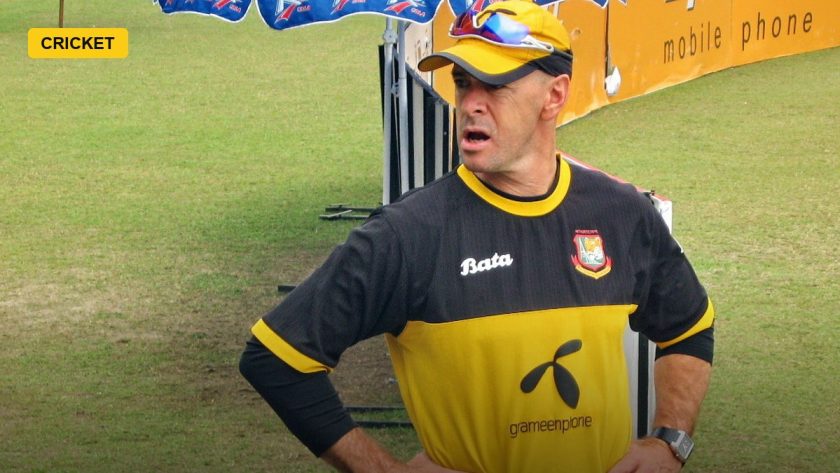
Sri Lanka Cricket has handed the reins of its women’s team to Jamie Siddons, the former Australian domestic batter and veteran international coach, appointing him head coach from 16 March 2026 on a one-year contract built around a single, clearly defined objective: preparing Sri Lanka for the ICC Women’s T20 World Cup in England.
A Short Contract With a Sharp Focus
The one-year term is unusually short for a head coach appointment, and Sri Lanka Cricket has been explicit that the mandate is tournament-specific rather than an open-ended rebuilding project. Siddons arrives with a coaching résumé that spans multiple national setups and domestic franchise cricket, giving him experience compressing preparation into short windows, precisely the skill Sri Lanka Cricket says it needed given how little lead time existed between his appointment and the tournament itself.
Why Sri Lanka Cricket Moved Now
The timing reflects Sri Lanka’s own recent history at the top table of women’s cricket. Sri Lanka’s win over India in the 2024 Women’s Asia Cup final in Dambulla signalled the team had genuine knockout-stage quality, not just occasional giant-killing form, and administrators were keen not to squander that momentum by leaving the head coach role unsettled heading into a global tournament. A short-term, high-intensity appointment was seen internally as lower risk than a longer contract that might not deliver results in time for England.
The Technical Brief
Siddons’ immediate priorities, according to Sri Lanka Cricket’s own framing of the appointment, centred on sharpening the side’s death-overs execution in both batting and bowling, an area where Sri Lanka’s otherwise disciplined cricket has occasionally come unstuck against the strongest opposition. His track record working with batting units in franchise cricket around the world is understood to be a specific factor behind the hire, with the board wanting technical refinement rather than a wholesale tactical overhaul in such a compressed window.
The Tension in Short-Term Coaching Appointments
Not all observers within Sri Lankan cricket circles are convinced short-term, tournament-specific coaching hires build anything durable. Critics argue that a one-year contract incentivises a coach to chase immediate results rather than invest in the structural changes, like emerging player development or domestic pathway alignment, that produce sustained success. Supporters counter that Sri Lanka’s board has limited resources compared with India, Australia or England, and that a focused, results-oriented appointment is a rational use of a smaller budget rather than a compromise.
How the World Cup Campaign Actually Went
Sri Lanka’s campaign under Siddons did not end in the final, with Australia and England contesting the title at Lord’s, but the tournament nonetheless served as the proving ground his appointment was built around. How far Sri Lanka progressed and how competitive they were against top-tier opposition will shape whether Sri Lanka Cricket extends his tenure beyond the original one-year window or opts for a fresh appointment once the contract concludes. The board has so far declined to commit publicly to an extension, preferring to let the full tournament body of work, rather than any single result, guide the decision.
What Comes Next for Sri Lanka
With the World Cup campaign now complete, Sri Lanka Cricket faces a decision point: extend Siddons and build toward the next ICC events with continuity, or treat the appointment as it was originally billed, a short, focused assignment now finished. Either way, the episode illustrates a broader trend among mid-tier boards of using specialist, short-term coaching hires to target specific tournaments rather than committing to multi-year contracts, a model that will be tested again as smaller boards balance ambition against budget through this World Cup cycle.
The broader lesson for mid-tier boards is that short-term, outcome-specific coaching contracts are increasingly common precisely because they are cheaper and lower-risk than multi-year commitments, even if they trade away the kind of long-term continuity that has helped Australia’s system produce repeat champions. Sri Lanka’s experiment with Siddons will likely be cited by other boards weighing the same trade-off in the years ahead, regardless of how the specific tenure concludes.
For now, the story remains one of calculated risk on both sides: Sri Lanka Cricket betting that a proven international coach can extract a step change in performance inside a single year, and Siddons betting that a short, high-profile assignment can enhance his own coaching reputation regardless of the eventual result. Few appointments in the women’s game this year have carried such a tightly compressed timeline for judgment.