
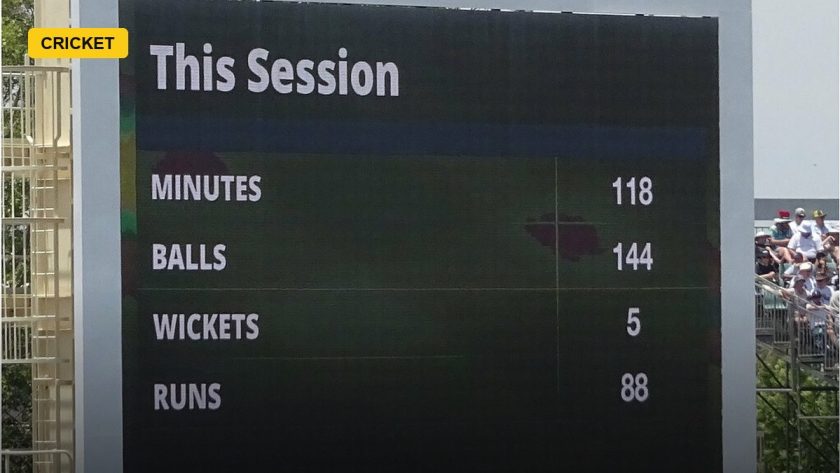
West Indies all-rounder Justin Greaves produced one of the most remarkable bowling spells in Test history on the third day of the first Test against Pakistan at the Brian Lara Cricket Academy in Tarouba, Trinidad, taking five wickets without conceding a single run and, in the process, bowling five consecutive wicket maidens — a feat no bowler had managed in the sport’s 149-year Test history. The 28-year-old’s 5 for 27 in 11 overs turned a competitive contest into a rout of Pakistan’s middle and lower order, and gave West Indies a first-innings lead they carried into the final two days of the match.
Pakistan’s Collapse From 244 for 3
Pakistan had looked comfortably placed at 244 for 3 in the middle session on Monday, built on Shan Masood’s composed century and a watchful innings from Imam-ul-Haq. Greaves, introduced as a change bowler, had Masood chopping onto his stumps in the very over that ended the opener’s fourth Test hundred, and from there Pakistan’s innings disintegrated. The tourists slid from 244 for 3 to 267 for 8 by lunch, with Greaves accounting for Aamer Jamal for 3, debutant Ali Usman for a duck, and wicketkeeper Mohammad Rizwan for 12 inside that same spell. He returned after the interval to have last man Mohammad Abbas caught behind, sealing figures of 5 for 27 as Pakistan were bowled out for 282, a lead of just 29 for West Indies after conceding 311 in their own first innings.
A Record 149 Years in the Making
The five straight wicket maidens eclipsed the previous mark of four, held by England’s Stuart Broad since a spell against South Africa in Johannesburg in January 2016. Greaves’ feat is now recognized as the first instance in Test cricket — a format dating to 1877 — of a bowler taking five wickets in five consecutive maiden overs. Statisticians noted that the raw figures, 5 for 0 across that unbroken stretch before he was eventually taken for runs elsewhere in his spell, make it one of the most economical five-wicket hauls ever recorded at this level, regardless of format.
Greaves’ Own Words
Speaking after play, Greaves credited a simple instruction from his captain for keeping him settled through the spell. “When I came on captain Roston Chase just said ‘continue to be disciplined in what you are doing’,” Greaves said, adding that while he was pleased with the outcome, “there’s still a lot of work to do” with the match delicately poised. It was the maiden five-wicket haul of his Test career, in what is just his sixth appearance in the format for West Indies, a side that has often searched for support seamers to share the workload with strike bowlers Shamar Joseph and Kemar Roach.
Chase’s Gamble Pays Off
West Indies captain Roston Chase’s decision to turn to Greaves for a longer spell rather than rotating his frontline quicks drew scrutiny in the build-up, given Greaves is primarily regarded as a batting all-rounder who bowls as a fourth or fifth option. Former West Indies players speaking on regional broadcast coverage argued the move vindicated Chase’s reading of a pitch offering variable bounce on the third day, while others cautioned that Pakistan’s batting collapse owed as much to poor shot selection under pressure as to unplayable deliveries, noting Jamal and Usman both fell to loose strokes rather than being beaten by superior craft. Pakistan’s camp, for its part, pointed to the pressure created by tight bowling at both ends rather than any single failing, with the tourists having added just 38 runs for the loss of five wickets in the session.
The Match Situation Heading Into Day Four
Greaves’ spell proved decisive to the shape of the contest. West Indies closed the third day at 126 for 7 in their second innings, extending their overall lead to 155 with Kemar Roach and Shamar Joseph at the crease, after 14 wickets fell across the day’s play — a tally that underlined how sharply conditions at the Brian Lara Cricket Academy had turned in the bowlers’ favor. Pakistan’s own pace attack, led by Khurram Shahzad and Mohammad Abbas, had earlier made early inroads into the West Indies second innings, keeping alive the tourists’ hopes of restricting the target on a final-day pitch expected to offer increasing turn and uneven bounce.
What’s Next
With two days of the Tarouba Test remaining, both sides face a familiar equation on a deteriorating surface: West Indies need quick runs from their tail to set a defendable target, while Pakistan’s bowlers, led by Abbas and Shahzad, will look to restrict any final push before their own batting order attempts a fourth-innings chase. The result here will set the tone for the second and final Test of the two-match series, with Pakistan captain Shan Masood under pressure to arrest a series slide in his first assignment leading the side in a home-and-away Test cycle since being reinstated to the role. For West Indies, a maiden Test five-for from Greaves adds a genuine bowling all-rounder option to a squad that has long searched for balance beyond its frontline pace trio, a development selectors will be watching closely as they plan for the upcoming World Test Championship cycle.